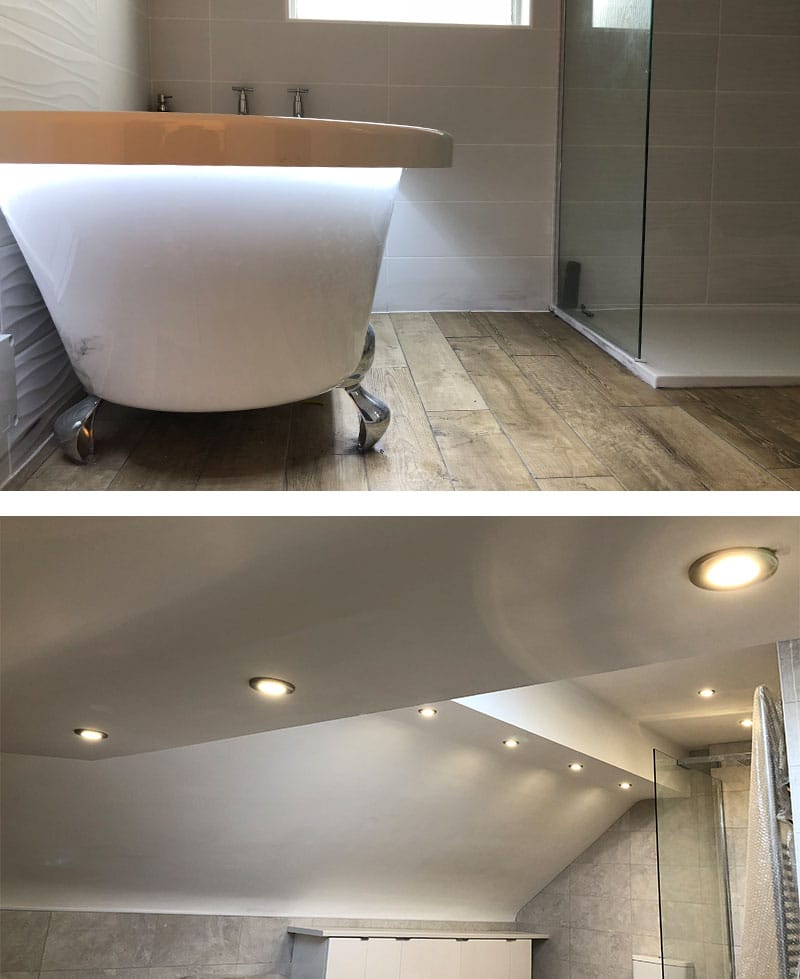
Be cautious when undertaking any electrical work in a bathroom, water carries electricity efficiently. When the two mix, the result can kill. Because of this, from an electrical safety point of view, the bathroom is possibly the most dangerous room in the home.
The consequences of an electric shock are far more severe in a bathroom or shower room as wet skin reduces the body’s resistance. There are special requirements for electrical installations in bathrooms.
Electrical equipment may be identified as having a certain level of mechanical and moisture protection, these are quoted as ‘Ingress Protection’ (or IP) numbers – such as ‘IPXY’, where X and Y are numbers, the X showing the level of mechanical protection and Y showing the level of moisture protection – in both cases, the higher the number, the better the protection.
If a piece of equipment does not have an IP number, it must not be used in zones 0, 1 or 2 (or elsewhere having a wet/damp environment).
The most common IP Codes are: IP67, IP65, IP44, IP20. For bathroom products you will find them clearly marked with its IP rating and the zone in which it can be installed, on some of the new fitting it will have a drawing on the box showing you where it can and can’t be fitted in the wetroom.
Typical electrical items which are marked with IP numbers include:
• Extractor fans
• Lighting
• Heaters
• Electrical shower units
• Shower pumps
Zone 0
Inside the bath or shower. Any fittings used here must be SELV (Separated Extra Low Voltage – max. 12Volts) and have a minimum rating of IP67 (protected against immersion in water – total immersion proof).
Zone 1
Above the bath or shower to a height if 2.25m. A minimum rating of IP44 is required. In this zone, if there is likelihood of water jets being used for cleaning purposes, a minimum of IPX5 is required.
Also, subject to IP rating, SELV or 240V luminaries may be used in this zone; if the fitting is 240 volts, a 30mA residual current device (RCD) must also be used to protect the circuit in this zone.
Zone 2
The area stretching to 0.6m outside the bath or shower and above the bath or shower if over 2.25m. An IP rating of at least IP44 is required. In this zone, if there is likelihood of water jets being used for cleaning purposes, a minimum of IPX5 is required.
Also, subject to IP rating, SELV or 240V luminaries may be used in this zone. In addition, it is a good practice to also consider the area around a wash basin (within a 60cm radius of any tap) as Zone 2.
Outside the zones – anywhere outside zones 0, 1, and 2. Where water jets are not to be used for cleaning purposes, the general rules of BS7671 apply. Here, there is no requirement for any lighting solutions to be protected against particles or solid objects, e.g. IPX4 – no IP rating required.
New 18th Edition IEE Wiring Regulations 2018 now require that additional protection shall be provided for all circuits by the use of RCDs having the characteristics specified in Regulation 415.1.1.
Regulation 701.411.3.3 means that all circuits, including lighting, electric showers, heated towel rails, etc., will require RCD protection, not exceeding 30mA.
17th Edition IEE Wiring Regulations introduced a change regarding supplementary equipotential bonding.
The Regulation states that where the location containing a bath or shower is in a building with a protective equipotential bonding system in accordance with Regulation 411.3.1.2, supplementary equipotential bonding may be omitted where all of the following conditions are met:
1. All final circuits of the location comply with the requirements for automatic disconnection according to 411.3.2,
2. All final circuits of the location have additional protection by means of an RCD in accordance 701.411.3.3,
3. All extraneous-conductive-parts of the location are effectively connected to the protective equipotential bonding according to 411.3.1.2.
• Sockets are not allowed in bathrooms or shower rooms (apart from shaver-supply units), unless they can be fitted at least three metres from the bath or shower.
• Shaver-supply units must be a safe distance from the bath or shower to avoid splashes
• Enclosed ceiling lights are preferable to pendant (ones that hang down) light fittings. All light fittings, that are not enclosed, should be out of reach of someone using, or still wet from using, the bath or shower.
• A ceiling-mounted pull-cord switch with the cord made of insulating material is the safest option for a bathroom. Standard wall-mounted light switches are a possible danger because of dampness and wet hands.
• Central heating is the safest way of keeping a bathroom warm. But, if you do have an electric room heater, it must be fixed at a safe distance from the bath or shower.
• Electric and gas water heaters in a bathroom must be fixed and permanently wired, unless they are powered by a socket fitted three metres from a bath or shower.
• Electric heaters should preferably be controlled by a pull cord or a switch outside the bathroom.
An electric shower must be supplied on its own circuit direct from the consumer unit.
Bring mains-powered portable appliances such as hairdryers, heaters or radios into a bathroom. You could be severely injured or die. You can get a fixed hairdryer with hot air delivered through a flexible plastic pipe installed in bathroomsBring mains-powered portable appliances such as hairdryers, heaters or radios into a bathroom. You could be severely injured or die. You can get a fixed hairdryer with hot air delivered through a flexible plastic pipe installed in bathrooms.
Bring mains-powered portable appliances such as hairdryers, heaters or radios into a bathroom. You could be severely injured or die. You can get a fixed hairdryer with hot air delivered through a flexible plastic pipe installed in bathrooms.